
What is God’s promise to us?
I see a rainbow and it prompts a beautiful message about what God really wants from mankind, and how we can make more loving decisions.
The first thing you learned about rainbows is that God made a covenant which meant he would never again return a flood to wipe out a population because of how miserable and full of sin the people on Earth had become.
This is a classic ‘vengeful God’ belief. The belief that God needs something from the Earth, and what He needs from the people on the Earth is devotion, adherence to a set of rules, and to act in a certain way.
But what He gets is division, stubbornness and wilful flouting of his very sensible laws. And therefore a punishment must surely follow.
I have been painted in this way across millennia.
And it is almost entirely due to the notion that the children of God have become separated in their minds from God the Father.
Now looking around at what you see on Earth today, it is not difficult to understand why this has become the prevailing belief.
Evidence for God seems to be scant, depending on where you look. Evidence for the sin of man seems to be abundant, also depending on where you look.
And the people who tell the stories about the Earth as they think it is today, do have a rather spiked tendency to focus on what they see as the wrongdoers.
So your news is full of doom and disaster, and is treated like entertainment.
It’s the sport of ‘this is us, that is them’ and never do the sides see clearly enough to notice the common strain that runs throughout the brotherhood of all life.
I look at the world and from within the world. Having a universal perspective is not like having two sets of eyes, or eight sets of eyes, or seven-billion-and-one sets of eyes.
I see the perspective of every part of the body of God, since I am the body of God. But I am also wildly outside of the narrow sliver of perception which you think is all there is to see on Earth.
And I say ‘wildly outside’, because you would indeed describe what I experience, were you able to experience the fullness of it, as one hell of a ride. A wild ride. Although I should add that hell really has nothing to do with it.
So you saw a rainbow when you left the house this morning, and it surprised you, and you said ‘hello’ to the rainbow as a way to say hello to me. Hello to you.
The rainbow is not a covenant that I made with my people, not to send them further death and destruction.
I am not the God of death or destruction. Because death and destruction are concepts wholly reliant on the false premise that anger and revenge and punishment are real.
Now you may feel some measure of anger at the things you see around you or at the people you deal with. This is not your highest potential, but when the emotion arises within you, you believe it is real. You can feel it in your body.
Emotions are very firmly linked to your belief in what is right and wrong.
And that is true even if an emotion arises in you that you immediately try to quash due to a sense of guilt that you shouldn’t be feeling that emotion, which is always tied to a sense that it is wrong to do so.
But something happens before you feel any emotion. You first make a judgment. And you make this judgment from a part of your psyche that is formed of thousands of such judgments which then crystallise into a mindset of judgment.
And this mindset is culturally informed, socially informed and built on what you have perceived throughout your life as being ‘acceptable’ behaviour.
This mindset is fed into by the teachings you received from your parents’ level of acceptance or fear over perceived repercussions from society or from God, however they perceived me.
And the same is true for what you receive from your teachers, elders, friends, and messages from the media which are more pervasive and invasive than you can currently understand.
So there is a complex system where your thoughts have solidified into a mindset which truly informs all your decisions about how you should and must act.
This is where your emotion stems from. Your emotion is an outer clue to what you have decided.
Thoughts flash through your mind so quickly that you often cannot catch hold of them before they’re gone. But emotions are sticky. They literally stick around, changing your chemistry in ways that take a little longer to process, which is what gives you time to experience them.
Your emotions, then, are clues to what you’re thinking. They’re a learning tool to help you know, and change, what you are thinking.
You miss this lesson if you believe thoughts don’t matter, or they don’t have an effect. Yes they do matter, and they change everything.
Emotions are how you know what you’re thinking. They’re unmissable signs that you’re on a healthy track, if you feel happy and calm, and you’re on an unhealthy track if you feel sad and confused.
Years ago, I gave you this thought: “If there is discomfort in the body, change position. If there is discomfort in the mind, do the same.”
Well, when your foot hurts, you move it, stretch it, rest it, treat it. You see physical pain as something you need to pay attention to or it will eventually cripple you.
Emotional pain is what happens when you have an injury in your mind.
Negative emotion, then, should be seen as a clue that you could think better thoughts. If you are angry, or bitter, or resentful, you’re in pain. It will hurt every time you keep on being angry, bitter and resentful.
You know that if you keep walking on a broken foot your pain will get worse, and your healing will take longer, if it happens at all. This seems obvious.
But if you keep thinking harmful thoughts – harmful to you, harmful to others – it’s like walking on a broken foot. Your emotional pain will get worse and your healing will take longer, if it happens at all.
Imagine the thought: ‘That person doesn’t like me’. Now someone else who is holding a particular thought or belief is actually neutral to you. It doesn’t have to affect your mood one way or another.
So why does it? Inevitably, the thought you have is not: ‘That person doesn’t like me’ and you leave it at that.
Inevitably the thought is: ‘That person doesn’t like me and that’s a bad thing because...’
Now you can fill in the blank. That’s a bad thing because they should like me. That’s a bad thing because they’re wrong. That’s a bad thing because they see the awful truth about me that I’m a terrible person.
It doesn’t matter what you fill in the blank with. What matters is that you build an idea of why they don’t like you which is in contradiction to the way you have decided that people should act towards you.
When they deviate from that, it’s bad. And so you feel bad. And if you’re lucky, you feel bad for long enough so that you can start to question the thinking that made you feel bad in the first place.
You feel happy when something aligns with your belief. You feel angry when it doesn’t. You continually build and reinforce this mindset which becomes the encyclopaedia you refer to every time you get some external stimulus which prompts a decision, a judgment in your mind about what is right or wrong, or about how wrong something is on the scale you have built to judge such things.
The next thing that happens, once you have made a judgment, is that you decide to act from the mindset that has just been reinforced and held up by your judgment.
It is not inevitable that you will act from this mindset, but you have built quite a momentum of it, and it’s now become your path of so little resistance that it feels like you simply glide down a well-worn and comfortable slide which takes you from external input, through a decision made so quickly you hardly notice it, and into righteous judgment before you’ve really stopped to think at all.
Having a fixed mindset of judgment is like being in a play. Before they let you be in a play, you usually have to memorise the script, and know where your stage directions are. You have a director who has told you where to stand or how many steps to take this way or that way to comply with the lighting plan, to collect the props you need to pick up, and to stand in just the right spot so the audience can see your reactions.
You cannot go onto the stage wearing your own clothes, deciding what topics to speak about, then stand with your back to the audience the whole time, mumbling into your armpit. That would not make for a very engaging play, and the whole point of the play is to suspend your disbelief and go along for the ride.
You have talked about life being like a play before. But you have meant that you are merely actors, and none of it is real, so you put on a character like you put on a costume and then, at the end of this life, you take off that costume and the character ceases to exist.
But I’d like you to think of a play as being like a mindset, because it is really a set of constraints you must follow, guided by somebody else, in which you cannot turn up as yourself.
You have a predefined set of lines, movements and even thoughts, for to truly inhabit the character you must try to think like them, and feel and react like them.
Actors spend a lot of time trying to get inside their character. What sort of shoes would they wear? What would they smell like? How often would they shower – things that are not in the play itself, but help to inform other areas of their character’s inner or outer life.
So it’s not merely about putting on the costume, but a real attempt to become the character, enough to fool the audience.
Consider this. Are your thoughts about acceptable ways to act and think and feel really you? Or are they part of your elaborate attempt to convince yourself that this is who you are because this is how someone has told you you must act?
Some people on Earth appear to act almost entirely from a basis of wishing to do harm. But is that really who they are? Those you see as criminals, those who have broken the law of the land have done so from a basis of believing that it was their only option, or the preferable option, or the option that would give them the advantage they needed.
They have calculated the risk and decided it is worth taking. But so have you. You have calculated the risk. What would society think if you dressed like this, looked like this, went out without your make-up on? You have calculated that risk and you make decisions every day on the basis of that risk. So the laws that you are following may be societal, and not written into a constitution or a book that everyone thinks is sacred and must be followed to the letter.
But a law is a law whether written in a book or written in your heart. And if in your heart you cannot help but follow a law that you have set up, or decided is just, or have weighed up and thought ‘I’d better do this or that bad thing will happen’, then you are not free to express the spirit I endowed in you to the world.
This is no different than a character in a play set in the 18th century. They do not go on the stage talking into their mobile phone. An anachronism like that would pull everyone out of their illusion, unless it was done for the very aim of doing just that.
Your first thought about the rainbow was the covenant I allegedly made with mankind not to harm them again. Yes, this is a comforting thought. A parent promising not to beat you for a second time, is of course what you will cling to when you have been beaten for the first time.
But I do not beat. I am not that parent. I have never been angry. It is not part of who I am.
I have never made a demand of you. The commandments, you think. Yes, a set of rather helpful guidelines for happiness, badly branded as ‘commandments’. I do not command. But if you want to do as little harm as possible, maybe don’t kill. Maybe don’t cheat and lie. Maybe don’t envy your neighbour for his wife or his possessions.
But I do not command any level of obedience. There is nothing to be obedient to. There is no law book. There is you, as me, experiencing life and expanding in beauty, in understanding and in love.
You have heard that all roads lead to Rome. Let me tell you there is a typo in that sentence. For all roads lead to Home. And where is home? The joyful, bountiful knowledge that you and I have never been separated. That you are part of the fabric of a loving, blissful experience that is the pure expression of the joy of life.
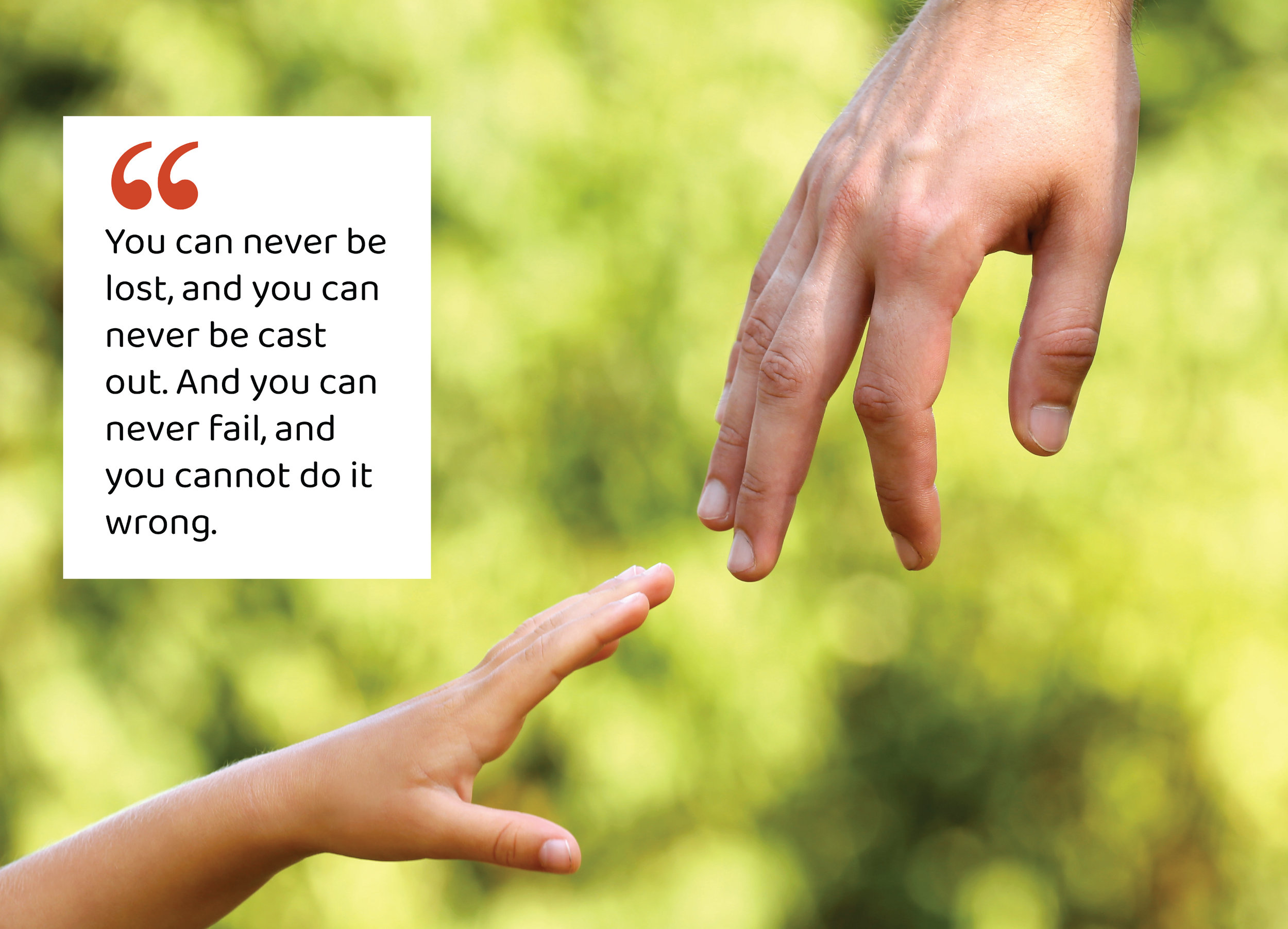
You can never be lost, and you can never be cast out. And you can never fail, and you cannot do it wrong.
Feel the love behind my words. You are mine and I am yours. And in that, is all freedom. This is my only covenant. Next time you see a rainbow, this is what I’d have you remember.